Most Malta SMEs are quietly funding their mobile provider’s margins without realising it. A handful of sales reps on bloated plans, roaming left on autopilot, and data bundles nobody uses — and suddenly your mobile spend looks like a second rent.
This post is about one thing: what a sensible monthly budget for Malta business mobile plans in 2026 looks like, and how to stop overpaying without leaving your team disconnected.
#How much should a Malta business pay per mobile line in 2026?
If you strip out marketing fluff and look at what Malta operators actually charge, a reasonable range for SMEs is:
- Light-use staff (office-based, mostly on Wi‑Fi): ~€12–€18 per line/month
- Standard business users (email, calls, Teams/Meet, some roaming): ~€18–€25 per line/month
- Heavy mobile users (sales, field teams, hotspotting, frequent travel): ~€25–€35 per line/month
According to published business mobile tariffs from local providers, typical 2026 business plans sit in that €15–€35 band for unlimited calls/SMS plus data between 10 GB and "unlimited" with fair-use caps.
Where Malta businesses usually go wrong:
- Paying €40+ per line for people who barely use mobile data
- Keeping legacy plans with outdated pricing instead of migrating to newer bundles
- Paying roaming add-ons for staff who almost never leave the island
For most SMEs, a healthy target is: Total mobile bill ≈ 0.5–1.0% of monthly operating costs. If your mobile spend is above that, it’s time to look under the hood.
#Business mobile vs personal plans in Malta: what’s the real difference?
A lot of small teams still run company phones on consumer plans because "it’s cheaper". Sometimes that’s true, but often it’s just unclear.
Here’s how business and consumer mobile typically compare for a Malta SME:
| Aspect | Business mobile plans | Consumer mobile plans |
|---|---|---|
| Monthly cost per line | Slightly higher headline price, better value at scale | Lower headline price, less control at scale |
| Support & SLAs | Business support channels, faster fault resolution | Standard consumer support queues |
| Billing & reporting | Consolidated invoice, per-line usage breakdown | Multiple scattered bills, limited usage visibility |
| Number management | Easier to add/remove/port lines for staff changes | More manual, often tied to individuals |
| Roaming options | Business roaming bundles, corporate controls | Consumer roaming, less policy control |
For a 3-person company, personal plans might be fine. For a 15-person team, that lack of billing visibility alone can cost more in admin time than you save in plan price.
The real cost of "cheap" consumer plans for a business is not the tariff — it’s the chaos of trying to manage staff numbers, usage and roaming manually once you pass 10–15 lines.
If your team is growing or you’re already feeling those admin pains, treat mobile the same way you treat choosing a business internet plan — structure and control matter as much as price.
#How Malta mobile plan pricing typically breaks down in 2026
To decide what you should pay, it helps to understand what you’re actually paying for:
-
Voice & SMS Most business plans in Malta now include unlimited national calls and SMS. If you still have per-minute pricing, you’re on a legacy plan and almost certainly overpaying.
-
Data allowance Entry business bundles usually start around 10–15 GB, mid-tier around 25–40 GB, and high/"unlimited" tiers with fair-use limits in the 60–100+ GB range. The jump from mid-tier to top-tier can easily add €8–€15 per line/month.
-
Roaming Under EU Roam Like at Home rules, roaming in EU/EEA is generally included at domestic rates with fair-use limits. Extra cost shows up for UK and non‑EU destinations, or for specific roaming add-ons.
-
Extras and hidden fees
-
Device instalments spread over 24–36 months
-
Add‑on bundles (extra data, international minutes) that nobody cancels
-
Paper bill or late payment charges
Before you argue with your provider, pull the last three months of invoices and group costs into:
- Pure service (plans and bundles)
- Devices
- Roaming
- Misc fees
That alone often exposes 10–20% savings with zero impact on staff.
#How many GB does your team actually need?
Most businesses guess data needs, then buy "safe" big bundles. That’s how you end up with everyone on 100 GB when half your staff use 5.
As a rule of thumb for Malta in 2026:
- Office-based staff on Wi‑Fi most of the day: 5–10 GB/month is usually enough
- Mixed office/field staff using email, collaboration apps, maps, some hotspotting: 20–30 GB/month
- Heavy field/sales staff regularly hotspotting laptops, using cloud CRMs and video calls on the road: 40–60 GB/month (or an unlimited plan with fair-use above that)
Two practical steps:
-
Audit last 3–6 months of usage Ask your provider or portal for per-number data usage. Sort lines into low, medium, high. If half your users sit under 10 GB, they shouldn’t be on the same plan as your top 10%.
-
Right-size by role, not by "fairness" It’s normal that sales have more data than accounts. What matters is that each role has enough — and that you stop paying for unused capacity.
If you’re already thinking about optimising other parts of your stack, that same "real usage vs headline spec" thinking is what we apply when comparing Microsoft 365 vs Google Workspace for Malta SMEs (/news/microsoft-365-vs-google-workspace-for-malta-smes).
#What should your total mobile budget look like? (examples)
Here are realistic 2026 examples for Malta SME teams using business-grade plans:
-
10-person office-first company
-
6 light users on ~€15 plans (10 GB, unlimited calls) → ~€90
-
4 standard users on ~€22 plans (25–30 GB, roaming-friendly) → ~€88
-
Estimated monthly mobile cost: ~€180–€220
-
20-person sales & field-heavy company
-
8 office users on ~€15 plans → ~€120
-
8 field/sales on ~€28 plans (40+ GB, EU roaming) → ~€224
-
4 managers on higher-tier ~€32 plans → ~€128
-
Estimated monthly mobile cost: ~€450–€520
If your numbers come out much higher than these for similar team profiles, you’re probably carrying:
- Old, expensive plans that haven’t been reviewed in years
- Too many lines for ex‑employees or shared devices nobody uses
- Roaming bundles and add‑ons left active "just in case"
For more structured cost thinking, the same approach we use when estimating the real cost of IT downtime (/news/how-to-calculate-the-real-cost-of-it-downtime-for-a-small-business) applies here: break mobile into per‑line cost vs business value.
#How to stop overpaying for Malta business mobile: a simple checklist
If you want to know whether your business is paying the right amount for mobile plans in 2026, work through this sequence:
-
Pull and review 3–6 recent mobile invoices Export them, group costs into service, devices, roaming and fees. Flag anything you don’t recognise or that feels "one-off" but repeats.
-
List all active numbers and owners Match each SIM to a real person or device. Cancel or park numbers that aren’t tied to an actual role. Ghost numbers can quietly burn hundreds of euro a year.
-
Check real data usage by number Request or download per-line usage. Build three buckets: under 10 GB, 10–30 GB, 30 GB+. Compare these to current plan tiers and identify obvious mismatches.
-
Align plans to roles, not individuals Define 2–3 standard profiles (office, field, sales/management) and assign matching plans. Avoid one-off customisations unless there’s a clear, documented reason.
-
Review roaming pattern and policies Look at where people actually travel. Switch from "everyone has roaming" to "roaming only for staff who travel". For frequent non‑EU travel, compare roaming bundles with local eSIM or Wi‑Fi-first calling.
-
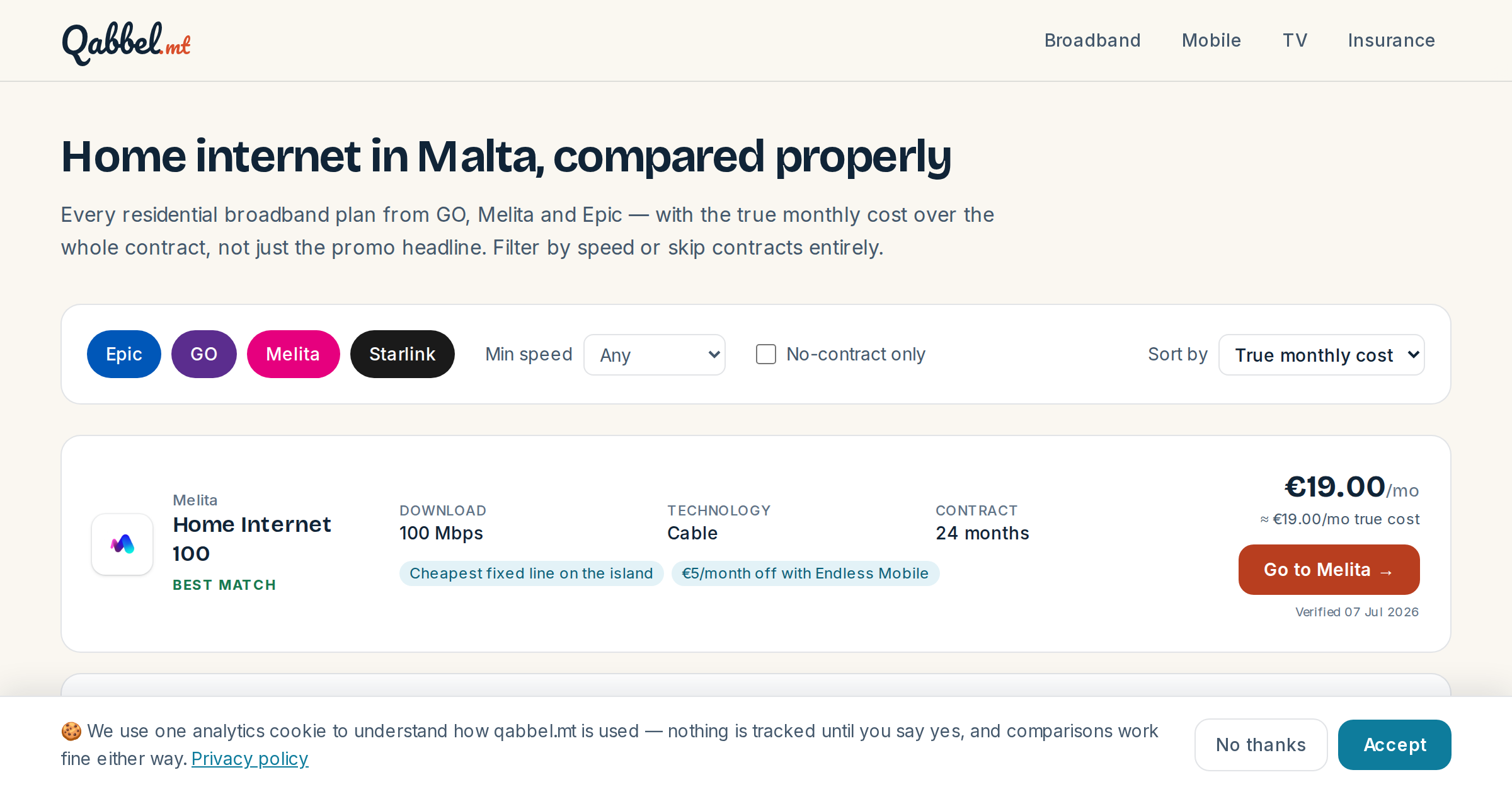
Compare current tariffs with 2026 offers Check what your provider is selling now for new business customers. If your plan is three+ years old, there’s often a better value bundle available. This is exactly why we built Qabbel.mt, a LimitBreakIT project that lets you compare every Malta internet, mobile and TV plan side by side before you lock into a contract.
-
Renegotiate or switch with a clear target budget Use a simple formula: Target monthly cost = Number of lines × target cost per line based on the ranges above. Go to your provider with those numbers and your usage data, not vibes.
If you want to stop worrying about mobile and telecom decisions, get in touch — we work with Malta businesses to make IT one less thing on your list.